
Imagine spotting the wrong sink model in a job file just before the slab is cut. You stop, check the specification, and get the drawing corrected. A few minutes of attention may have prevented a remake and a difficult conversation with the customer.
That is a useful way to think about your next pay rise.
A stronger case for higher pay starts with the work a shop can trust you to handle: the problems you recognize, the quality you deliver, and the responsibility you can take on. Those skills can develop on the saw, at the polishing bench, in the drawing office, or on an installation crew.
If you want to earn more in countertop work, start by identifying where you can make the biggest difference to a job.
Catch problems before they reach the next person
Every stage of countertop production depends on the information passed into it. A measurement, drawing revision, or material choice can affect the work that follows.
For a countertop templater, progress might mean handling a more complicated site and producing clear measurements and notes. For a machine operator, it might mean recognizing a mismatch between the program and the approved drawing before cutting. For an installer, it might mean identifying a site-readiness problem early enough for the team to resolve it.
These are practical skills to develop. The Natural Stone Institute’s complex-templating training specifically connects measurement accuracy with reducing rework and time on site.
When you discuss your contribution with an employer, use a real example. Explain what you noticed, what you checked, and how the team resolved it. Give credit to the people involved.
Develop your CNC programming, setup and quality-checking skills
Being comfortable with a CNC machine is a starting point. There is more to learn about preparing jobs, checking toolpaths, understanding the setup, inspecting finished pieces, and looking after the equipment.
Northwood’s stone-machine training covers drawing, importing, programming, corrections, operation, and maintenance. Those topics offer a useful guide to where an operator could develop next.
Programming can be one route. So can becoming particularly capable at setup, quality checks, or diagnosing production problems within your training and authority. Choose the skills that fit the equipment and work in your shop.
Be specific when describing your experience. Name the machine and software, then explain what you actually do with them. Loading an approved program, adjusting a setup, and creating a program involve different responsibilities. An employer needs to understand which ones you can handle independently.
Make your craftsmanship easy to see
Good hand skills deserve a place in any conversation about earning more.
Seam finishing, color matching, miter assembly, and consistent edges are all specific capabilities you can demonstrate. The Natural Stone Institute’s seaming course teaches several joint types alongside color matching and finishing. Cosentino’s fabrication resources also distinguish between materials and tasks, with guidance on cutouts, miters, polishing, and installation.

Build a small portfolio of work you are allowed to share. Include close photographs and a short explanation of your part in the job: the material, the detail that required care, and the work you completed.
A polished photograph alone cannot show everything. Pair it with a clear account of your responsibilities and a reference who can speak about your consistency. Protect customers’ privacy and get permission before sharing identifiable projects.
Take a job through to completion
Experience on installations can also lead toward crew leadership or coordination.
That involves checking that the job is ready, making sure the right people and equipment are available, communicating changes, and following up on outstanding work. It requires judgment as well as organization.
The Natural Stone Institute’s shop-drawing training explains how drawings communicate material choices and design details to customers, fabrication teams and installers. Taking responsibility for that handover means making sure the next person has the information they need, and flagging anything that is still unresolved.
You do not have to become a manager to develop these habits. Clear notes, an early phone call about a problem, and a complete handover can help the next person do their job. If you want to lead a crew, ask for an agreed opportunity to take on part of that responsibility and receive feedback.
Make reliability part of your skill set
An employer needs to know what happens when the work becomes awkward, a customer is unhappy, or the plan changes.
Can you explain the problem clearly? Follow the agreed process? Ask for help before a mistake grows? Accept a correction and apply it next time?
O*NET’s occupational profile for stone cutters and carvers identifies attention to detail and dependability as important work styles. In a countertop shop, you can demonstrate those habits by keeping accurate job notes, following through on agreed tasks, and reporting mistakes promptly.
Make your communication easy to act on. If a sink specification changes, identify the affected drawing, record the approved change, and confirm who needs the update before production continues. That gives your team a clear next step.
Safe working practices belong in the same picture. OSHA’s silica resources include countertop-specific guidance, exposure-control information and training materials. Develop your skills using the proper equipment and procedures, and raise problems when the conditions do not support safe work.
Four skills to demonstrate at your next pay review
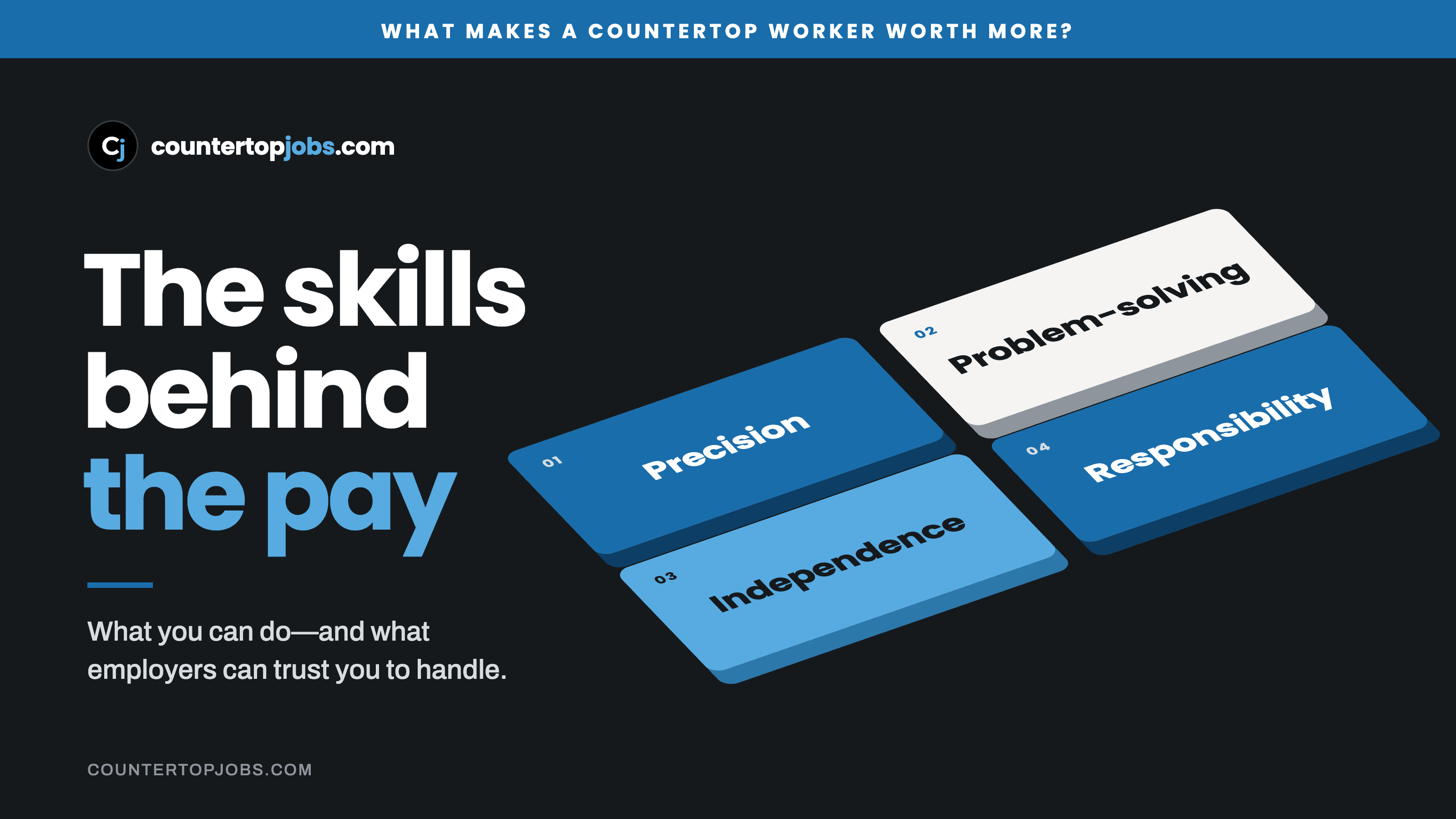
Think about a job your supervisor would trust you to handle. What would you check, which decisions could you make, and what would you hand over? Use these four skills to choose examples from your own work.
Read all four skills and examples
| Skill | On the job | At your pay review |
|---|---|---|
| Precision | Get the details right. Check measurements, cutouts and finishes against the approved job information. | Show the care behind your work. Bring a drawing or close-up photo. Explain what you checked and how you confirmed it was right. |
| Problem-solving | Catch problems early. Spot a mismatch before work continues. Explain the issue and help the team agree on a solution. | Explain a problem you helped solve. What did you notice? What action did you take? What happened next? Be clear about your contribution. |
| Independence | Handle more with less supervision. Complete work within your training, keep the team informed and recognize when you need support. | Show what you can now handle. Walk through a job you completed with less supervision. Explain the decisions you made and where you asked for help. |
| Responsibility | Follow through to completion. Check your work, communicate changes and leave the next person with a clear handover. | Demonstrate your follow-through. Bring a completed job record, handover notes or supervisor feedback showing how you followed through. |
Build your skills on the job. Bring real examples to your next pay review.
These examples can help you prepare for a pay review. Agree with your employer which responsibility you will take on next and how you will demonstrate it.
Compare hours, overtime arrangements, benefits, travel, and the work expected. A skill can strengthen your position, but the offer still depends on the employer and the role.
Explore the related lessons: Countertop details · How countertops are made · Shop machines · Countertop software · Job planning · Shop roles
Where to find countertop fabrication and installation training
Ask your employer which training options are available through the shop’s suppliers and industry memberships.
Caesarstone Master of Stone offers online learning and working guidelines for fabricators, with a certificate for completing its training modules. Ask your employer about access; Caesarstone directs users who need a company code to their sales manager.
Stone Fabricators Alliance runs events hosted by member companies, covering topics from hand fabrication to shop management. These are opportunities to see demonstrations, ask questions, and learn from other fabricators. Events are free for members in good standing; check membership eligibility and travel costs before booking.
Cambria University provides training for Cambria business partners in fabrication, installation, digital templating, repairs, and operations. It offers in-person and virtual learning. Its training brochure lists tuition as free, with attendees responsible for arranging travel and accommodation.
Choose training that fits the work you want to take on, then agree with your employer how you will practice and demonstrate the skill.
Build your knowledge with our free learning portal
Our free Countertop Jobs learning portal introduces countertop materials, shop roles, equipment, and the steps from planning to installation. Whether you are new to the industry or want to understand the work around your role, it is a practical place to build your knowledge and decide what to learn next.
Explore the free learning portal →
Turn your next pay review into a specific plan
Before asking for a raise, write down three things: the work you now handle independently, examples that show the quality of that work, and the next responsibility you want to learn.
Then ask your manager to agree on the standard and the review date. You might discuss taking an approved job through setup and inspection, handling a more demanding template with suitable support, or coordinating part of an installation schedule.
Choose an achievable responsibility with the training and equipment it needs. Agree how success will be assessed and how it relates to pay. This gives both sides something concrete to review.
You do not need to learn every role in a countertop shop. Develop a skill the business needs, demonstrate it consistently, and make your contribution clear.
Looking for a role that fits your experience? Tell Countertop Jobs what you can do and where you want to work. Include your materials, machines, responsibilities, preferred location, and pay expectations.