
Countertop Templater Jobs: Digital Skills and Hiring
What a countertop templater does, how digital measurements reach production, and the skills to include in a job description. Wage comparisons explained.
Contents10 sections
Digital templating has changed what the countertop templater’s job actually consists of. The person who used to cut strips and hot-glue a physical pattern on site now runs a measuring device and hands off geometry that ends up driving a saw. Those are different skills — and plenty of job ads still describe the older version of the role.
This guide focuses on recruiting for the templater role: the site skills, file responsibilities and production communication a brief should describe. It also explains why nearby government occupation categories cannot provide an official countertop-templater salary.
Key takeaways
- The vocabulary may be shifting from the tool to the output. US searches for “digital templating” roughly doubled over the twelve months to July 2026 — from 480 a month to 1,000 — while “laser templating” drifted down from 170 to 140. We offer that as a hypothesis, not a finding: two rounded, low-volume search curves cannot prove a trade is renaming a job.
- There is no federal occupational code for a countertop templater. Not one — no BLS estimate isolates this role. Any templater wage figure you find is therefore a proxy, or an estimate derived from job postings.
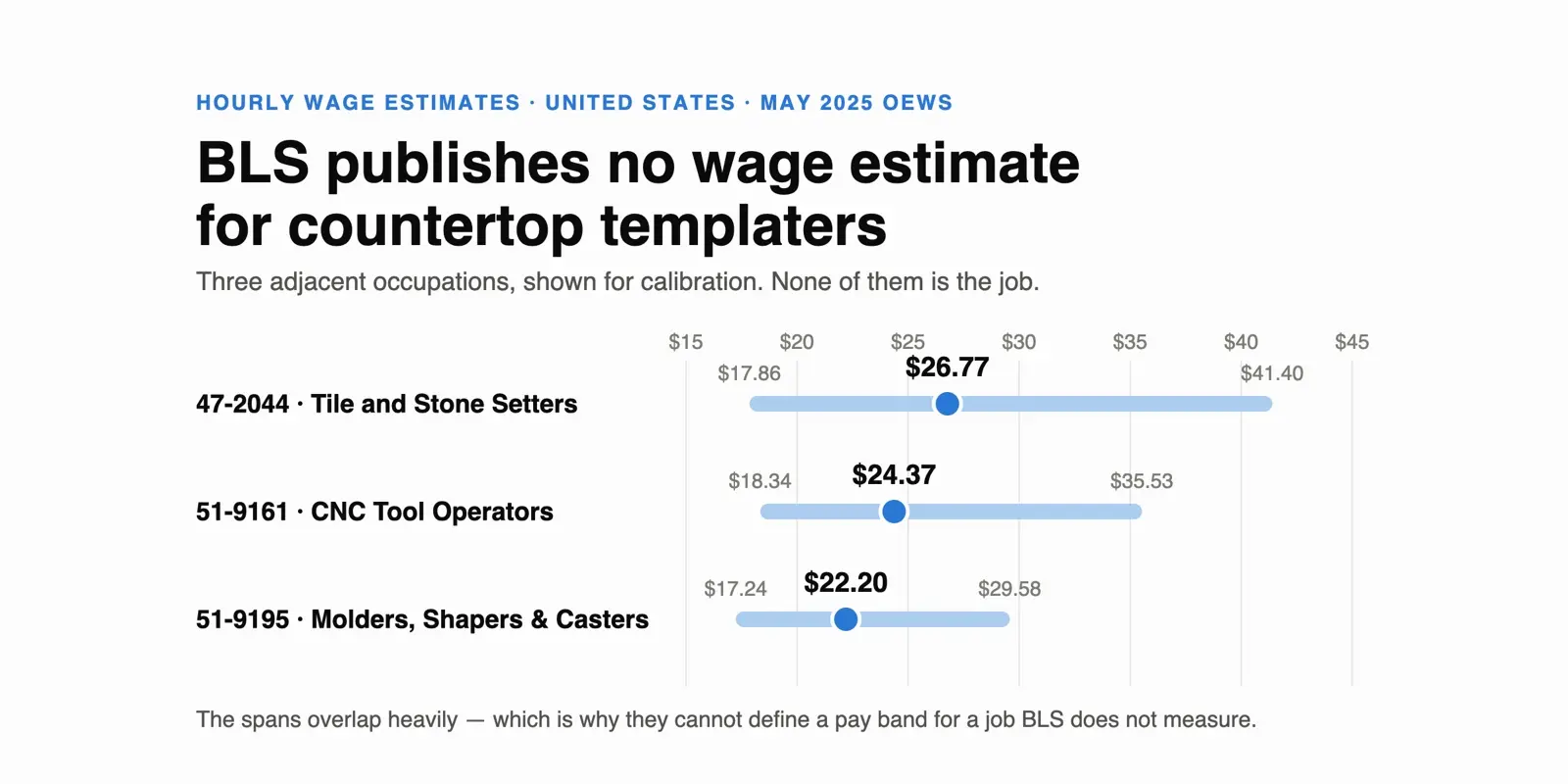
- The occupations that bracket this role are estimated a long way apart. At the 90th percentile, BLS estimates $41.40 an hour for Tile and Stone Setters and $29.58 for Molders, Shapers and Casters. Neither is a templater wage — but that spread is the context a shop should have before setting a pay grade.
- There is a CAD dimension to the job now. A digital templater produces geometry that feeds the CAD/CAM workflow which ultimately drives the sawjet, CNC or bridge saw. Hiring for measuring skill alone, without file discipline, leaves a gap somebody downstream has to cover.
- We could not find any independent measurement of whether digital templating is more accurate. The time-saving and error-rate figures in circulation trace back to vendors. We say so, because the rest of the internet doesn’t.
What the search data shows
The research behind this article included US search volumes for the trade. These are average monthly searches over the twelve months to July 2026, with the Keyword Planner competition index in brackets:
- “digital templating” — 590 a month (competition 27, low). Rising: 480 to 1,000 across the year.
- “laser templating” — 170 a month (39). Falling: 170 to 140.
- “countertop templating” — 140 a month (7, very low). Falling: 110 to 90.
- “how to template countertops” — 70 a month (0). Flat.
- “templater jobs” — 40 a month (11). Flat.
First, “digital templating” doubled year over year. July 2025 was 480; July 2026 was 1,000, the highest month in the series, and the whole curve steps up through the back half. One twelve-month series cannot rule out seasonality on its own, so treat this as suggestive movement rather than a settled trend — we’ll know more with another year of data.
Second, it is rising while “laser templating” falls. For years the category was named after the instrument — a laser templator, an LT-55. One reading is that the trade has stopped thinking of it as “the laser” and started thinking of it as “the digital file” — a small linguistic shift with a large hiring consequence, because a laser is something you operate and a file is something you are responsible for.
We want to be honest about how much weight that will bear: it is a hypothesis, not a demonstrated fact. Two rounded, low-volume, cross-industry query curves diverging could equally reflect bucket noise, advertiser campaign activity, or two different audiences searching. It is consistent with what we see in job ads. It is not proof.
One honest caveat: “digital templating” is not exclusively a countertop term. Marine, glass and flooring shops template digitally too, and Prodim’s Proliner is sold into all of them. Some of that 590 is not our industry. “Countertop templating” at 140 is the clean, unambiguous slice.
What actually changed about the job
Physical templating is a craft skill. You read the space, you account for walls that aren’t square, you build a pattern out of strips, and the accuracy lives in your hands and your judgment. The output is a physical object that goes back in the truck.
Digital templating doesn’t remove the craft — it redistributes where the craft has to show up. The measuring is faster and the device handles the geometry, but three responsibilities grow in importance.
- File integrity. The captured geometry feeds the CAD/CAM workflow — where seams, offsets, cutouts, slab layout, nesting and toolpaths may be reviewed or resolved — which then drives the sawjet, CNC router or bridge saw. Error control shifts toward device setup, complete capture, validation and clean handoff. Accuracy still depends heavily on the operator, and errors in either method can escape detection and reach fabrication; a bad physical template is not necessarily visibly bad either. If an error passes validation, it may surface only during fabrication or installation, when correction is more expensive.
- CAD literacy. Someone has to validate the file — and sometimes clean or adjust it, though a good capture may need neither. In smaller shops that’s the templater. Larger shops may separate field templating from CAD/CAM programming into two hires; where that happens it’s usually a sign the shop has outgrown a single combined role.
- Customer-facing judgment, unchanged but now on a clock. Seam placement, overhang, sink and cooktop cutouts, whether that wall is going to be a problem. Digital tools don’t decide any of this. The templater still does, just with less time on site to think about it.
That third point matters more than it sounds. Digital capture can shorten the measurement portion of a site visit. What we can’t put a number on is how much that compresses the thinking time around it, because complexity varies enormously job to job and some seam and layout decisions get made back at the shop anyway. Shops that treat templating as purely a measuring task tend to discover the difference the expensive way.
One shop where the split is visible: the careers page of Euro Stone Craft (Virginia/DC), checked 18 August 2026, lists Template Technicians and CAD/CAM Programmers as two separate roles, alongside CNC Operators, Sawyers and Installers. That’s one structure at one company — a single careers page establishes nothing about the industry, and we cite it as an illustration rather than evidence of common practice.
The wage data problem — and what it reveals
Here is something you will not find stated plainly anywhere else: the US federal statistical system has no occupational code for a countertop templater.
The Bureau of Labor Statistics publishes wages by Standard Occupational Classification. There is no SOC for templating. There isn’t even a good one for countertop fabrication generally — the trade is scattered across several codes, none of which is a clean match. O*NET’s closest detail occupation, 51-9195.03 Stone Cutters and Carvers, lists Stone Fabricator, Polisher and Granite Cutter among its reported titles. Templater is not among them.
So no BLS estimate isolates countertop templaters, and the figures on the big job aggregators are estimates derived from job postings rather than published statistics. We’re going to use comparators — occupations near this one that BLS does measure, shown to give a sense of the neighbourhood rather than to stand in for a templater’s wage. The difference is we’ll tell you which ones, and where they break.
None of these three occupations is countertop templating, and their spans overlap heavily — which is exactly why comparing their percentiles cannot establish a pay band for a fourth occupation BLS does not measure at all. The figures behind the chart at the top of this page, national, May 2025 estimates, hourly, as 10th percentile, median and 90th percentile:
- 47-2044 Tile and Stone Setters — $17.86, $26.77, $41.40. A field-installation comparator, not a templating proxy. 35,850 employed nationwide in the whole SOC.
- 51-9161 Computer Numerically Controlled Tool Operators — $18.34, $24.37, $35.53. A CNC machine-operation comparator. 169,450 employed nationwide.
- 51-9195 Molders, Shapers and Casters, Except Metal and Plastic — $17.24, $22.20, $29.58. A broad fabrication comparator, not countertop-specific. 33,190 employed nationwide.
Every one of those is imperfect, in a specific direction.
- 47-2044 includes tile setters who never touch a slab — probably most of it.
- 51-9161 has a task mismatch, not just an industry one. It is overwhelmingly metal machining — 169,450 people is a manufacturing number that stone CNC work happens to sit inside — but the deeper problem is that running a CNC implies neither CAD/CAM programming nor field templating. We include it as a comparator for the machine work downstream of a template, and it should not be read as a wage proxy for templating.
- 51-9195 is monument- and architectural-heavy. Only a minority of it is countertop work.
- We have deliberately not used 47-2022 Stonemasons. That is architectural masonry — wall and structure work — with national employment of just 7,820 and different employers entirely. It gets quoted for this trade constantly and it is the single most misleading number in US stone-industry content.
Now the useful part — and we’re going to be careful about how far it stretches. At the 90th percentile, BLS estimates $29.58 an hour for the broad fabrication comparator, $41.40 for the field-installation comparator and $35.53 for the CNC machine-operation comparator. That is a spread across three different occupations, none of which is templating. A 90th-percentile estimate is not a ceiling, and comparing percentiles across adjacent codes does not establish that a templater belongs in one band rather than another. Anyone telling you these numbers prove templaters are underpaid is doing arithmetic the data doesn’t support.
What the spread is good for is calibration. Skilled work in this trade is estimated anywhere from the high twenties to the low forties an hour at the top end, depending on whether the day is spent in a shop or on a customer’s site. So the question worth asking is a practical one, not a statistical one: if your templating role now involves on-site customer-facing judgment plus responsibility for geometry that drives expensive machines, does your pay grade still reflect a shop-floor measuring job? We can’t answer that from federal data. But the people who can do both halves of this job have somewhere else to take those skills, and that is a hiring problem whatever the percentiles say.
What shops should actually hire for
Rewrite the ad around the file, not just the tape. Non-negotiable:
- Genuinely careful measurement habits and the discipline to re-check. This is still the core.
- Comfort with a measuring device and its software — most vendors train on their own system, so device-specific experience is a nice-to-have, not a filter.
- Enough CAD literacy to recognise when a file is wrong before it reaches the saw.
- Customer-facing composure. They are in someone’s kitchen, often selling the seam decision.
- A clean driving record and a valid driver’s license. Ask for a CDL only if the vehicle you’ll actually assign requires one. The usual trigger is 26,001 lb GVWR/GVW or GCWR/GCW, and a Class A combination is triggered by towing a trailer rated over 10,000 lb behind a qualifying vehicle; passenger and hazmat rules can also require a CDL (air brakes alone do not). Check your own fleet rather than putting CDL in the ad by default — if it isn’t required, it filters out good applicants for nothing.
Reasonable to train:
- The specific templating system. Shops routinely advertise “no prior digital templating experience required — we train.”
- Shop-specific tolerances, seam conventions, and how your CAM setup wants files delivered.
Where the good candidates come from: experienced installers who already read spaces well, and CNC operators who already think in files. Those two groups convert well in opposite directions — the installer needs the file discipline, the CNC operator needs the on-site judgment.
Two things not to put in the ad:
- “Apprenticeship,” used loosely. There is no single nationally standardised countertop-fabrication apprenticeship pathway; employer-provided training is common. Registered programs do exist under broader stonecutter, stonemason and tile/marble classifications, and individual sponsors run their own — so if you genuinely operate a structured program, call it what it is. Just don’t use the word as a synonym for “we’ll train you,” because a US applicant may read it as implying a formal registered pathway that your shop doesn’t have.
- “OSHA 10/30 certification.” These are course-completion cards, not certifications — OSHA says so explicitly. Shop owners notice.
If you’re on-site templating in occupied homes, the install-side work is generally governed by the construction silica standard (29 CFR 1926.1153), while fixed-shop fabrication generally falls under general industry (29 CFR 1910.1053). Applicability follows the work, not the job title — worth getting right before you write safety expectations into a job description.
What this means if you’re the templater
Your job got more valuable and the market hasn’t fully repriced it yet. Three practical things:
- Learn the CAD side properly, even if your shop doesn’t formally ask you to. It’s the part of the role that transfers, and it’s what separates a $22-an-hour version of this job from a $35 one.
- Keep your remake rate, and be able to say it out loud in an interview. Almost nobody can. It’s the most persuasive number a templater can carry.
- The Natural Stone Institute’s Silica & Slab Safety Certificate is a trade-specific certificate an individual worker can actually hold — worth knowing about in a trade where most credentials, NSI accreditation included, belong to companies rather than people. It runs about four to six hours online, is free to NSI members and $199 otherwise, and its videos are captioned with subtitles in several languages including Spanish. It won’t transform your pay, but it’s a real, checkable line on a résumé.
A note on the numbers everyone else is quoting
You’ll find confident figures circulating about digital templating: template time cut by 50 to 70 per cent, accuracy within 0.5 to 1.5 mm versus 3 to 6 mm for cardboard, remake rates of 1 to 3 per cent versus 4 to 8 per cent, payback in six to twelve months for shops doing 15 or more jobs a month.
Those are vendor and vendor-adjacent figures. They come from companies that sell templating systems or tooling. They may well be broadly right. But we could not find an independent study measuring templating accuracy or remake rates across US countertop shops, and we are not going to launder marketing numbers into fact by repeating them without saying where they came from.
If you have real remake data from your own shop, we’d genuinely like to see it — that’s a number the industry needs and doesn’t have.
A countertop templater job description checklist
- Site work: name the measuring system, typical job types, travel area and who confirms the site is ready for the visit.
- File ownership: specify who cleans up the measurements, adds the job details and approves the file for production.
- Handoffs: explain the software and file format, who receives the output, and how changes or missing information are recorded.
- Experience: distinguish familiarity with a device from independently completing a site visit and resolving a production query.
- Support: identify the person a templater can contact when the site differs from the plan, and describe the training available.
A candidate can mirror these headings in a resume: the device used, the work completed personally and one example of a difficult handoff. Employers can add the city, shift and pay range using the hiring brief checklist. For broader pay context, see the Texas and Florida salary guides; neither provides an official wage series for countertop templaters.
Methodology and limitations
- Search volumes: Google Ads Keyword Planner, geo target 2840 (United States), English, twelve months to July 2026, pulled 26 August 2026. Keyword Planner reports rounded buckets and suppresses terms below roughly ten a month; a zero means “below the floor or suppressed,” not “nobody searches this.” The competition index reflects advertiser competition, not organic difficulty.
- Wages: BLS Occupational Employment and Wage Statistics — May 2025 estimates, the latest available as of 26 August 2026 (May 2026 estimates expected spring 2027). National, cross-industry, nominal hourly, wage-and-salary workers only; retrieved via the BLS Public Data API v2, with datatype codes verified against the BLS oe.datatype definition file. OEWS publishes annually and BLS explicitly discourages using it for time-series analysis, so nothing here should be read as a wage trend — for wage growth, the Employment Cost Index is the correct source. OEWS also excludes self-employed workers, which is part of why these headcounts look low relative to how many people you would expect to be doing the work.
- The central limitation: there is no SOC code for countertop templating, so no figure in this article is a published wage for this occupation. All three codes used are labelled comparators with the biases stated above.
- Industry scope: this article is about engineered stone (quartz) and natural stone countertop fabrication and installation. NAICS 327991 (Cut Stone and Stone Product Manufacturing) is the closest fit for shops primarily cutting and finishing stone, but it is not countertop-exclusive — it also contains monuments and other cut-stone products. Standalone installation businesses may sit under 238350, 238340 or 238140 depending on the work, while installers employed by a fabrication shop ordinarily carry that shop’s classification, though a separately organised installation establishment may receive its own code. None of this is about architectural or building stonemasonry, which is a different industry with different employers, different codes and different pay.
Sources
- US Bureau of Labor Statistics, Occupational Employment and Wage Statistics, May 2025 — retrieved via the BLS Public Data API v2.
- O*NET (sponsored by the US Department of Labor, Employment and Training Administration) — occupational titles for 51-9195.03 and 47-2022.
- OSHA, 29 CFR 1910.1053 (general industry) and 29 CFR 1926.1153 (construction), respirable crystalline silica.
- OSHA Outreach Training Program — the status of OSHA 10 and 30 course-completion cards.
- Natural Stone Institute — Silica & Slab Safety Certificate.
Published by
Countertop Jobs
Countertop Jobs recruits for the US countertop trade — fabricators, countertop installers, CNC operators, sawyers, templaters, polishers and shop managers — for fab shops across the country. We write about the work: what shops pay, what the machines and the material actually demand, and what changes on the floor.
Where this article quotes numbers, the sources and the workings are set out in how we put these figures together.
Figure look wrong, or out of date for your market? Tell us and we’ll fix it.