
Countertop Seams: Layout, Quality and Installer Skills
Understand countertop seam planning, the limits of published tolerances, and what to ask fabricators, templaters and installers about their own work.
Contents9 sections
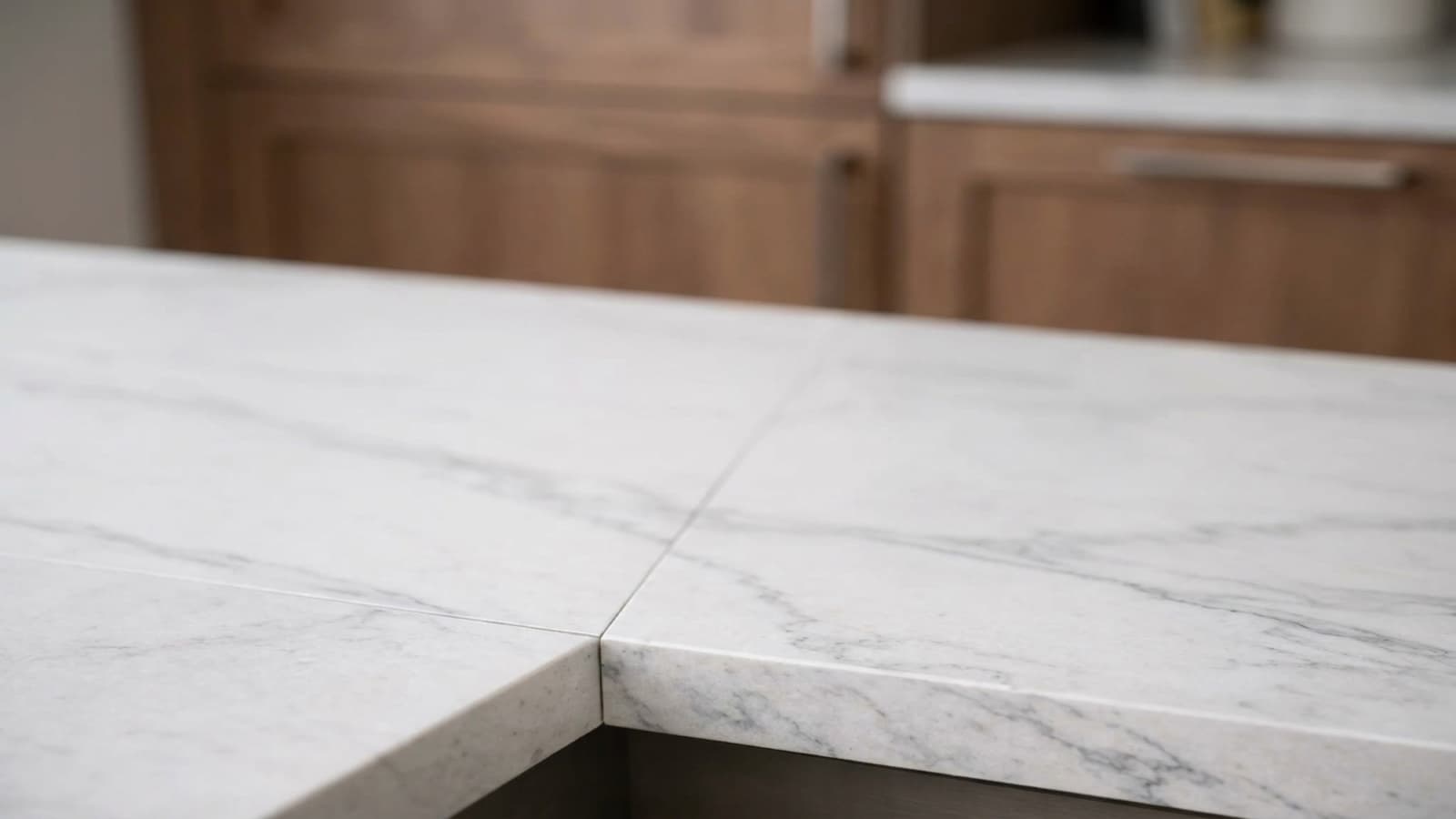
A seam is the joint where two pieces of stone meet. Almost every countertop has at least one, and the single most common question a fabricator gets asked is why — usually followed, a little suspiciously, by whether the one in front of the customer is any good.
For a countertop installer, seam quality is also a communication task. The site, template, shop layout and installation need to agree on what is being joined and where. This guide explains the decisions and reported guidance behind a seam, with the source limits stated alongside the numbers.
Key takeaways
- Seam position is a planning decision shared across templating, fabrication and installation, with the actual site and material in view.
- Reported natural-stone tolerances are not a universal specification for engineered quartz or every fabricated joint. Check the applicable source and supplier guidance.
- When assessing experience, ask who made the decisions and how issues were documented. A claim that a seam is “invisible” does not explain the work.
Countertop Jobs focuses on recruiting fabricators and installers. This article approaches seams from the shop’s side: the planning, communication and workmanship a role may involve.
Why your countertop has a seam at all
Stone arrives at a shop as a slab, and a slab is a fixed size. Many conventional quartz slabs run roughly 120 to 126 inches by 55 to 56 — about ten feet by four and a half — which is somewhere near 46 to 49 gross square feet before any trimming, depending on the brand. Jumbo sizes are larger again, commonly around 126 to 130 inches by 63 to 65, and some current products are bigger still. Granite and other natural stone vary more, because a slab is whatever the block gave up when it was cut.
So the first constraint is simple arithmetic — though not quite as simple as the slab size suggests, because nominal length is not all usable once the slab is trimmed and squared, defects are worked around, and the pattern is laid out. A straight run comfortably shorter than the usable length can often be cut from one piece with no seam at all. An L-shaped kitchen, a long island, or a run that turns a corner usually cannot, because the shape will not fit inside the rectangle the slab actually is — not without wasting so much material that the job stops making sense.
The second constraint is one customers rarely think about: getting the stone into the room. A 3cm slab is heavy enough that a large piece needs several people and clear space to move. Stairwells, tight hallways, doorways and turns all impose their own limit, and a piece that would have been perfectly cuttable in one sheet sometimes gets split simply because there is no physical route to carry it in whole.
A kitchen with no seams is therefore usually a small kitchen, or one where a great deal was spent on an oversized slab. It is not, on its own, evidence of better work.
Who decides where the seam goes
Within those constraints there is real choice, and that choice is most of the craft. A fabricator laying out a job is solving several problems at once, and they pull against each other.
- Yield. The pieces have to fit on the slabs you have bought. Move a seam and the layout may no longer fit, or may cost another slab.
- Pattern. On veined material the seam should let the veining run across the joint rather than stop dead at it. Matching a vein costs material, because the two pieces have to be taken from a particular place on the slab.
- Strength. Stone is weakest where material has been removed. A narrow strip in front of a sink or a cooktop is the most fragile part of a countertop, which is why fabricators reinforce those spans and think carefully about what runs through them.
- Sightlines. A seam in the middle of the run you look at every morning is more noticeable than the same seam tucked near a wall or aligned with a cabinet line, even when both are cut equally well.
- Access. Whatever the layout says, each piece still has to physically reach the room.
A good shop will tell you where the seams are going before it cuts, and can explain why each one is there. That conversation is worth asking for. If nobody can say why a seam lands where it does, that is itself informative.
What a good seam actually measures
Here is the part most customers are never shown. Secondary sources quoting the Natural Stone Institute’s Dimension Stone Design Manual report specific tolerances for natural stone work. Note the scope before you use them: that manual governs natural dimension stone, so for engineered quartz, porcelain or sintered stone the manufacturer’s own fabrication and installation instructions and the project specification take precedence. As reported, they are:
- Seam width. A nominal 1/16 inch — about 1.5mm — with a tolerance of roughly ±1/64 inch. Wider than that is a specified choice, not a default.
- Lippage — one side sitting higher than the other. No detectable lippage at the front or rear edge of a countertop. Toward the centre, a maximum of about 1/32 inch, or 0.8mm.
- Flatness. Variation from the required plane of roughly 1/8 inch over ten feet. Flatness and level are separate properties and the reported figure concerns deviation from plane, not whether the run is level.
Those numbers are small, and that is the point — a step you would struggle to describe is still a step that is out of tolerance. Running a fingernail across the joint is the test people reach for instinctively, and it is genuinely useful for telling you a step is there. What it cannot do is tell you how big it is: a nail catches on considerably less than 1/32 inch, and whether it catches also depends on the sharpness of the edge, any filler, the surface finish and which direction you run it. Treat it as a way to find lippage, not a way to measure it. Establishing that a step exceeds tolerance takes a straightedge and a gauge.
Being honest about our sourcing: the Dimension Stone Design Manual is a paid publication and we have not read it first-hand. The figures above are as reported by two independent sources that agree with each other — the stone and tile consultancy CTaSC, and the manual’s tolerances chapter as republished by stone distributors. We would rather say that than present it as a first-hand citation. If you are holding a shop to these numbers in a dispute, buy the manual.
Two things the standard does not measure, which matter just as much: whether the colour of the adhesive was matched to the stone, and whether the veining lines up across the joint. Both are judgement, not tolerance. A seam can be perfectly within spec and still look wrong because the epoxy is grey against a cream stone, or because a strong vein runs to the joint and then jumps two inches sideways.
The sink question, which the trade genuinely disagrees about
Search for countertop seams and you will quickly find people asking why theirs runs through the middle of the sink. It is one of the most common complaints, and it is worth being straight about: this is a real disagreement inside the trade, not a settled rule that some shops break.
The argument for seaming at the sink is that the opening shortens the visible joint and lets the rest of the run stay unbroken — and that splitting there avoids transporting and setting a large piece with a fragile U-shaped cutout in it, which is a handling argument as much as an aesthetic one. The argument against is that the narrow rails in front of and behind a sink cutout are already the weakest part of the countertop, and putting bonded joints in them concentrates two weaknesses in one place. Note the seam is not hidden either way: portions of it normally remain visible on the front and rear rails.
We are not going to adjudicate that from a desk. What we can say is that a shop should be able to tell you which approach it takes and why, and that any seam near a cutout should be reinforced. If the answer is a shrug, that is the problem — not the seam’s position.
What a bad seam tells you
A seam is the one part of the job where fabrication skill becomes visible to someone who knows nothing about stone. Everything else — how square the cuts are, how the edges were polished, how well the template was taken — is either hidden or looks fine to an untrained eye. The seam is not. It sits at eye level in the middle of a kitchen for twenty years.
That makes it a fair proxy for the work behind it. A tight, flat, well-placed, colour-matched seam means somebody templated accurately, cut precisely, planned the layout with the pattern in mind, and took time setting it on site. A wide or stepped one usually means at least one of those went wrong — and the same hands did the rest of the kitchen.
Which is worth saying plainly, because it cuts both ways. Shops that employ good fabricators and installers produce seams you have to hunt for. That is not luck or better stone. It is who is on the bench and who is on the truck.
If you think your seam is bad
- Look at it in daylight, from standing height, from where you normally stand. Not from six inches away with a flashlight — no seam survives that, and no standard asks it to.
- Run a fingernail across it. If it catches there is a step — but that tells you lippage exists, not that it exceeds tolerance. Measuring it takes a straightedge and a gauge.
- Check the edges specifically. The reported natural-stone guidance allows no detectable lippage at the front or rear edge, so a step you can feel there is a stronger complaint than the same step mid-run.
- Photograph it with something for scale before you contact anybody.
- Raise it with the fabricator, not the retailer, and ask which tolerance they build to. Many reputable shops publish their own workmanship standards and will point you to them.
Documenting the concern and identifying the applicable guidance gives the fabricator a specific issue to assess. Appearance alone cannot establish the cause or whether a particular tolerance applies.
Questions for a countertop installer or templater
- Who chose the seam position on a recent job, and what information did you pass between the site and the shop?
- How did you confirm that the installed pieces matched the agreed layout before the final handover?
- Describe a mismatch or unexpected site condition. Who did you contact, what did you record and how was the next step agreed?
- What did you explain to the customer about the finished seam, care instructions and any unresolved issue?
An installer job description should identify responsibility for site checks, seam work and customer communication. Use our countertop hiring brief checklist to describe that scope. For a different fabricated joint, read the mitered-edge guide.
Sources and limits
- Tolerances: Natural Stone Institute, Dimension Stone Design Manual. A paid publication; figures cited here as reported by CTaSC (Donato Pompo) and by the manual’s tolerances chapter as republished by stone distributors. We have not read the manual first-hand and say so rather than implying otherwise.
- Slab dimensions: commonly cited industry figures for standard and jumbo quartz slabs. Sizes vary by manufacturer, material and supplier, and natural stone varies more than engineered — treat them as typical, not as a specification.
- The sink-seam question is presented as contested because it is. We have not found an authoritative standard that settles it, and we would rather say so than pick the answer that reads more confidently.
- This article is about fabricated stone countertops in the United States — quartz, granite, marble and quartzite. Laminate, solid surface and butcher block are jointed differently and none of the tolerances above applies to them.
Published by
Countertop Jobs
Countertop Jobs recruits for the US countertop trade — fabricators, countertop installers, CNC operators, sawyers, templaters, polishers and shop managers — for fab shops across the country. We write about the work: what shops pay, what the machines and the material actually demand, and what changes on the floor.
Where this article quotes numbers, the sources and the workings are set out in how we put these figures together.
Figure look wrong, or out of date for your market? Tell us and we’ll fix it.